Model Swap
This page explains how to replace a model backend in Red Hat OpenShift AI Models as a Service without changing anything from the customer’s perspective - same API key, same model ID. The key is the MaaSModelRef abstraction layer that decouples the customer-facing API from the actual inference backend. Customers must use the body-based routing (BBR) endpoint (/v1/chat/completions) for seamless swaps.
All file paths and oc apply commands in this guide are relative to the CAI-Field-Manual-MaaS repository root. Make sure you have cloned it and are working from its root directory (see Getting Started).
Overview
A model swap is the process of replacing the inference backend behind a model without affecting customers. Typical scenarios include:
- Upgrading to a newer model version (e.g. Qwen 3.6 to Qwen 3.8)
- Replacing a GPU model with a more efficient one
- Moving from a simulator to a real model (or vice versa)
- Switching hardware (e.g. different GPU type or node pool)
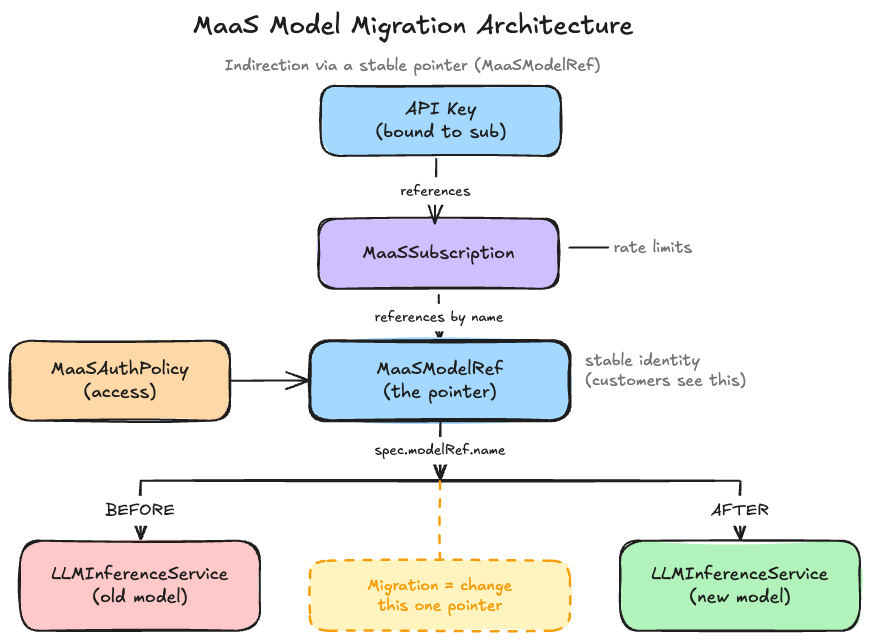
The swap works because MaaSModelRef acts as an indirection layer. Auth policies, subscriptions, and API keys all reference the MaaSModelRef by name - they have no knowledge of which LLMInferenceService sits behind it. Swapping the backend is a one-field patch.
Resource Hierarchy
Understanding how resources relate to each other is critical for a safe swap. Some resources are created by the admin, others are auto-created by maas-controller.
| Resource | Namespace | Created By | Role |
|---|---|---|---|
| LLMInferenceService | llm (model ns) | Admin | Defines the inference workload: container, model weights, resources, gateway routing. This is the actual serving pod. |
| MaaSModelRef | llm (model ns) | Admin | Registers the model with the MaaS control plane. Points to an LLMInferenceService (or ExternalModel) via spec.modelRef. This is the stable identity that customers interact with. |
| MaaSAuthPolicy | models-as-a-service | Admin | Controls who can access the model. References MaaSModelRef by name + namespace. |
| MaaSSubscription | models-as-a-service | Admin | Defines rate-limiting tiers. References MaaSModelRef by name + namespace. API keys are permanently bound to a subscription at creation time. |
| HTTPRoute | llm (model ns) | Controller (KServe) | Routes traffic from the Gateway to the model pod. Created automatically when the LLMInferenceService is deployed. |
| TokenRateLimitPolicy | llm (model ns) | Controller (maas-controller) | Enforces token rate limits from MaaSSubscription. Owned by the HTTPRoute - garbage collected when the HTTPRoute is deleted. |
| AuthPolicy (singleton) | Gateway ns | Controller (maas-controller) | Shared gateway-level auth policy. One per gateway, not per model. |
The Abstraction Layer
The diagram below shows how the resources connect. The MaaSModelRef is the pivot point - everything above it (auth, subscriptions, API keys) stays the same during a swap. Only the pointer below it (to the LLMInferenceService) changes.
MaaSModelRef Phase Transitions
The MaaSModelRef goes through these phases:
| Phase | Meaning |
|---|---|
| Pending | Backend is initializing or no governance pairing found yet. |
| Ready | Backend is healthy AND at least one MaaSSubscription + MaaSAuthPolicy pair is active. Inference is possible. |
| Unhealthy | Governance is attached but the backend has a runtime or health failure. |
| Failed | Non-recoverable reconciliation error. |
| Invalid | The resource spec is missing or structurally invalid. |
Governance means at least one MaaSSubscription AND one MaaSAuthPolicy both reference the same MaaSModelRef. Both are required for the model to reach Ready phase. These two CRDs are independent - updating one does NOT auto-update the other. For details on keeping them in sync, see Governance Pairing in Phase 5.
What Changes vs What Stays the Same
| Component | Changes? | Why |
|---|---|---|
| LLMInferenceService | Yes | New backend deployed (qwen-38), old one deleted (qwen-36). |
MaaSModelRef spec.modelRef.name | Yes | Pointer swapped from qwen-36 to qwen-38. |
| MaaSModelRef name | No | qwen-coder is the stable identity that customers see. Keeping it the same is what makes the swap seamless. |
| MaaSAuthPolicy | No | References MaaSModelRef qwen-coder by name (unchanged). |
| MaaSSubscription | No | References MaaSModelRef qwen-coder by name (unchanged). |
| API keys | No | Bound to a subscription at creation time. Subscription is unchanged, so keys keep working. |
| Model ID in requests | No | Both qwen-36 and qwen-38 serve the same spec.model.name (Qwen/Qwen3-Coder), so the canonical model ID (publishers/llm/models/Qwen/Qwen3-Coder) stays the same. |
BBR endpoint (/v1/chat/completions) | No | Body-based routing uses the canonical model ID in the request body (publishers/llm/models/Qwen/Qwen3-Coder), derived from the namespace and spec.model.name (both unchanged). Customers using this endpoint need no changes. |
Per-model URL path (/llm/<name>/...) | Yes | The per-model URL path changes from /llm/qwen-36/... to /llm/qwen-38/... because it is derived from the LLMInferenceService name. Customers using per-model URLs must switch to the BBR endpoint. |
The per-model URL path changes after a swap: /llm/qwen-36/v1/chat/completions becomes /llm/qwen-38/v1/chat/completions because it is derived from the LLMInferenceService name, not the MaaSModelRef name. Always use the BBR endpoint (/v1/chat/completions) with the full publisher model ID in the request body (e.g. publishers/llm/models/Qwen/Qwen3-Coder) for swap-safe client integration.
Prerequisites
- Phases 1-5 completed (Red Hat OpenShift AI installed, Models as a Service platform running,
llmnamespace created) - Admin access to the model namespace and
models-as-a-servicenamespace
Swap Procedure
This procedure walks through the full swap lifecycle using the provided Qwen 3.6 -> 3.8 simulator templates. Both templates use the CPU simulator image (llm-d-inference-sim), so no GPU is required.
The scenario: you have a model called qwen-36 registered with MaaS through a MaaSModelRef called qwen-coder. You want to replace it with qwen-38 without affecting customers.
If you already have a model deployed from Phase 5, you can skip the original model deployment and adapt the steps to your existing model names.
Step 1: Deploy the Original Model
Deploy the original model (qwen-36) with its full MaaS stack (MaaSModelRef, AuthPolicy, Subscriptions):
Wait for the model to become Ready:
Expected output:
Step 2: Deploy the Replacement Model
Deploy the replacement (qwen-38) alongside the existing one:
The new LLMInferenceService must use the same spec.model.name as the existing one. Both qwen-36 and qwen-38 use Qwen/Qwen3-Coder. This is the model ID that customers send in their API requests (/v1/chat/completions). If the names differ, customers would need to update their client code.
Step 3: Verify the Replacement is Ready
Wait for both LLMInferenceServices to be running:
Expected output - both old and new show a Ready condition:
For GPU models, this can take 5-15 minutes while the image is pulled and model weights are loaded.
Step 4: Swap the MaaSModelRef Pointer
This is the swap itself. Patch the MaaSModelRef to point to the new LLMInferenceService:
This one-field change is what makes the swap seamless. The MaaSModelRef name (qwen-coder) stays the same, so all auth policies, subscriptions, and API keys continue to work.
Verify the MaaSModelRef now points to qwen-38:
Step 5: Delete the Old LLMInferenceService
While both LLMInferenceServices exist, the gateway routes 100% of BBR traffic to qwen-36 (the first-created backend) and 0% to qwen-38. You must delete qwen-36 so the gateway starts routing to qwen-38.
This means the swap is not zero-downtime. There is a brief window (typically a few seconds) between deleting the old model and the gateway routing to the new one where requests may fail.
This deletes the old inference pods, its HTTPRoute, and frees any GPU resources it was using.
Step 6: Clean Up Stale TokenRateLimitPolicy
After swapping the MaaSModelRef and deleting the old LLMInferenceService, the TokenRateLimitPolicy (TRLP) may retain an owner reference to the old HTTPRoute. This causes the MaaSSubscription to go Failed because the TRLP references a non-existent route.
Delete the stale TRLP so the controller can recreate it with the correct owner reference:
The maas-controller will automatically recreate the TRLP, now correctly owned by the new HTTPRoute.
Step 7: Verify
Confirm that everything is healthy:
Test inference to confirm the swap worked. If you already have an API key from before the swap, use it - the whole point is that existing keys keep working. If you need a new one:
Send an inference request using the BBR endpoint:
A successful response confirms the swap is complete - the request was routed to qwen-38 using the same model ID and API key that worked with qwen-36.
The model ID in the request body must be the full publisher path as returned by /v1/models (e.g. publishers/llm/models/Qwen/Qwen3-Coder). Using the short name (Qwen/Qwen3-Coder) returns a 404.
Operational Notes
BBR Routing Conflict
When two LLMInferenceServices in the same namespace share the same spec.model.name, their HTTPRoutes create identical BBR match rules. The gateway accepts both routes but routes 100% of traffic to the first-created backend - the new model receives zero requests. This was validated on OpenShift 4.21: 10/10 requests hit the old pod, 0/10 hit the new one. Deleting the old LLMInferenceService removes its HTTPRoute and lets the gateway discover the new one. There is no way to “test the new model first” while the old one exists.
TokenRateLimitPolicy Stale Owner Reference
The TokenRateLimitPolicy is auto-created by maas-controller and owned by the HTTPRoute. When the MaaSModelRef pointer changes, the TRLP still references the old HTTPRoute. Deleting the TRLP (Step 6) lets the controller recreate it with the correct owner. If you skip this, the MaaSSubscription may go Failed with an error like: Object <namespace>/maas-trlp-<name> is already owned by another HTTPRoute.
endpointOverride
If you created the MaaSModelRef manually (not through the Kustomize manifests in Phase 5), the controller may not be able to auto-discover the endpoint URL. In that case, set spec.endpointOverride on the MaaSModelRef:
You can check if this is needed by looking at the MaaSModelRef status. If it is stuck in Unhealthy with an empty endpoint, endpointOverride is the fix.
Model ID Format
The model ID used in inference requests (/v1/chat/completions) is the full publisher path, not the short model name. For example:
- Short name:
Qwen/Qwen3-Coder - Full publisher path:
publishers/llm/models/Qwen/Qwen3-Coder
Always use the model ID as returned by the /v1/models endpoint to avoid 404 errors.
Template Manifests
The manifests/99-model-swap/ directory contains two concrete simulator-based templates that walk through the full swap lifecycle (Qwen 3.6 -> 3.8):
Both templates use the CPU simulator image (llm-d-inference-sim), so no GPU is required. Both share spec.model.name: Qwen/Qwen3-Coder - this is the invariant that makes the swap seamless.
The qwen-36/ directory includes the full MaaS stack (MaaSModelRef + AuthPolicy + Subscriptions) because it is the original deployment. The qwen-38/ directory only includes the LLMInferenceService because the MaaS governance resources persist unchanged across the swap - only the MaaSModelRef pointer changes.
For a real swap with GPU models, replace the container image, model URI, and resource requests in both model.yaml files to match your actual models.
References
- Architecture & Request Flow - full Models as a Service component overview and request lifecycle
- Phase 5: Model Deployment - how to deploy a model from scratch
- Upstream MaaS Documentation